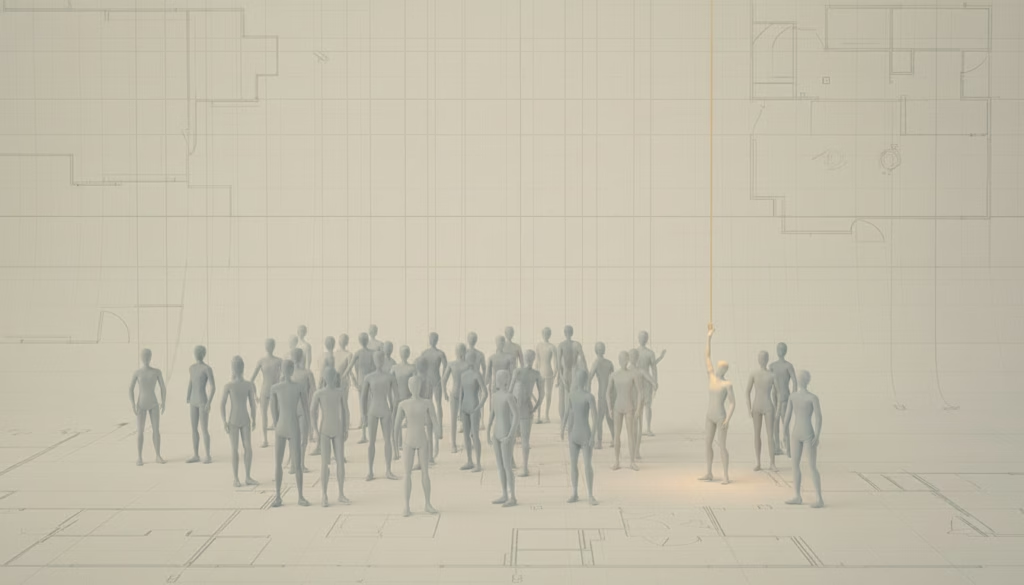
Where’s Waldo? Finding the Human in Human-AI Collaboration at Design Firms
A human visible in AI-assisted work is not always governing it. Patrick Scannell and Mike Keene on how design firms find the human in human-AI collaboration.
Design firms must consider how AI shapes their thinking environment, becoming an intelligence habitat that influences what they notice, remember, and value in their work. As AI accelerates the pace of change, firms must ensure that human agency governs AI-assisted workflows and that AI enhances—not diminishes—the capabilities of practitioners and the firm as a whole. To navigate this shift, firms should adopt a lifecycle framework that emphasizes human judgment, ownership, and decision-making across project stages, ensuring that AI serves as a capacity-building gym rather than a mere performance prosthetic.
Listen to This Article(AI-generated)
0:00
0:00
Adapted by the Design Futures Council from articles Patrick Scannell wrote for attendees of DFC’s September 2026 Leadership Summit, and from his conversation with Mike Keene at the summit.
Walk into almost any conversation about AI in design firms and you will hear the same three questions. Which model should we standardize on? Which workflows can we automate? Which roles are exposed?
Those questions are real. They are urgent, and they have budget attached. But they are downstream of a quieter question that is much harder to put on an agenda: what kind of thinking environment does a firm become once AI is inside it?
Answering it means seeing the firm differently. Not as a business, a studio, or a roster of talent, but as an intelligence habitat: an environment that shapes what people notice, what they remember, how they argue, and what they eventually recognize as good work.
AI changes that habitat whether or not anyone designs the change. And the change raises two questions that turn out to be genuinely hard. If a human remains visible throughout an AI-assisted workflow, how do we know whether that human is actually governing it? And when the work is done, what did AI actually help?
Why a habitat, and why now?
Designers already know that environments are not neutral. A corridor changes who meets whom. A threshold changes who feels invited. And the built environment is no longer just physical; it is layered with sensors, dashboards, and digital twins. A building is still a building. Increasingly, it is also an interface. If design leaders do not define the human purposes of these hybrid environments, someone else will define them by default, and the default will be whatever is easiest to measure.
The firm is an environment too, and it already thinks. It thinks through sketches, redlines, site visits, precedent studies, and critique. A project archive thinks. A fee structure thinks, often more decisively than anyone intends. AI is a new participant in a system that was already distributed.
That is why habitat is the right word. A habitat is a set of conditions that determines what can live in it, what thrives, what atrophies, and what becomes normal without anyone voting on it.
Those conditions have always shifted, usually slowly enough for a firm to adjust. What is different now is the pace, and the reason lies in how people think. Humans think in three streams at once. We think biologically, with nervous systems shaped over evolutionary time. We think culturally, inheriting language, institutions, and norms. And we think materially, extending cognition into tools, media, buildings, screens, and now machines that produce language and work. Biology moves across millennia. Culture moves across generations. Material cognition used to move across centuries, from the printing press to the drafting table to the calculator. It now moves on a release cycle measured in months, sometimes days.
That rate mismatch is the engine underneath most of what feels disorienting right now. The strain in a firm is not a failure of adaptation. Three systems that used to change together have become unsynchronized, and the tools now move faster than judgment can absorb them. A firm’s review rituals, apprenticeships, and instincts took years to form. Now each new release can reshape them in months, quietly resetting what counts as normal practice before anyone has decided whether it should.
Fig. 1 · Three streams of thinking
Toggle to compare the pace of material cognition.
Biologicalacross millennia
Culturalacross generations
Materialacross centuriesmonths, sometimes days
Bar lengths are illustrative, not to scale.
Where does the habitat change first?
The strain shows up first in four places.
Memory.
Most firms know far more than they can reach, and much of it lives as folklore. A model never sees the firm, only what the firm has put into words. Why a principal knows one pursuit is right, what a seasoned project leader notices before the risk is visible, how a client’s trust was built over twenty years: almost none of it is written down. Hand a model a thin or skewed archive and it will make ignorance more fluent.
Judgment velocity.
AI can generate options faster than people can evaluate them, and polish arrives before understanding. Production friction is usually waste. Judgment friction is sometimes wisdom.
Apprenticeship.
AI lets junior people produce senior-looking work before senior judgment has formed. The question is whether the path by which a person becomes a designer survives the compression.
Afterlife.
Every technology leaves habits, dependencies, and forgotten skills behind. Before adopting a system, ask what it will teach the firm to stop doing.
All four shifts lead to the same place. In consequential work, a human being usually remains visible throughout: briefing, reviewing, approving, signing. Yet the framing, the priorities, and the sense of what mattered can migrate into the system without anyone noticing the transfer, because nothing on the surface looks different.
The transfer is also lossy. What the system holds is a representation of the firm, and it is always thinner than the firm. Work from that representation long enough and the firm begins to resemble it. Visible participation is not the same thing as governing agency. Telling the two apart becomes the Waldo question.
“Visible participation is not the same thing as governing agency.”
What is the Waldo test?
In 1942, Robert Heinlein published a story about an inventor named Waldo, who built remote manipulators to extend his reach. Engineers borrowed the name, and a waldo came to mean a machine through which a human extends agency into the world.
Fifty years later, Vernor Vinge turned the picture over. In A Fire Upon the Deep, a vastly more capable artificial intelligence acts through human beings who remain, to all appearances, entirely themselves. The human becomes the waldo.
The children’s puzzle asks you to find a human figure in a crowded field. The professional version has consequences attached: can you locate the governing human inside a seamless human-AI performance?
One answer is to run Alan Turing’s 1950 test backwards. The Waldo test asks: if someone observed the entire production cycle, would they find evidence that a governing human was present? A moment where purpose was set, a frame was rejected, a claim was checked against something outside the conversation, or a question was asked that the model would never have known to ask. Was the person the AI’s waldo, or the other way around?
Fig. 2 · The Waldo test
Every figure is visible. Click to find the one who is governing the work.
Presence is not the test.
Present in the meeting. Not governing.
Reviewed the deck. Not governing.
Approved the output. Not governing.
Signed the drawings. Not governing.
Wrote the prompt. Not governing.
Credited on the work. Not governing.
Found. A moment where purpose was set, a frame was rejected, or a claim was checked against something outside the conversation.
What does the framework look like?
It starts with a lifecycle of eight roughly sequential stages that keeps the governing question visible across a project.
Stage
The work
1. Orientation
Define the goal(s) of the undertaking in human terms
2. Context
Build the world the model will reason inside
3. Decomposition
Split the job into inspectable parts; delegate to the appropriate asset
4. Interaction
Specify purpose, authority, and limits; draft the work accordingly
5. Exploration
Enlarge the possibility space
6. Challenge
Attack the emerging answer (red-team)
7. Verification
Test against genuinely independent constraint
8. Synthesis
Decide, and own the decision
Two threads run through all eight. Provenance recognizes that ordinary version control records how an artifact changed, while firms now need a record of how judgment changed. Formation asks whether the people doing the work are becoming more capable. One dial, Governance, scales the rigor to the consequences.
Fig. 3 · The eight-stage lifecycle
Select a stage.
Governance dial
1. Orientation
Define the goal(s) of the undertaking in human terms
2. Context
Build the world the model will reason inside
3. Decomposition
Split the job into inspectable parts; delegate to the appropriate asset
4. Interaction
Specify purpose, authority, and limits; draft the work accordingly
5. Exploration
Enlarge the possibility space
6. Challenge
Attack the emerging answer (red-team)
7. Verification
Test against genuinely independent constraint
8. Synthesis
Decide, and own the decision
Governance dialOne dial at the center of all eight stages. It scales the rigor to the consequences.
The lifecycle’s first test ran the eight stages on one of Pat Scannell’s own draft working papers. An AI-detection tool rated the draft 91 percent likely machine-generated, and the tool was not wrong. The eight-stage audit found what the detector could not. Human governance was strong in orientation, context, exploration, and challenge. It was thin in decomposition and interaction, and verification was absent. A detector gives the artifact a score. The lifecycle helps the people and the work get better.
What did AI actually help?
Finding the governing human is half the problem. The other half appears once the work is delivered. The question is not whether AI helped. Of course it helped, and it will help more. The question is what it helped. Did it help the artifact while weakening the practitioner? Did it help the team meet the deadline while thinning the firm’s memory? Did it help the leader approve faster while seeing less?
The same tool can be a prosthetic or a gym. A prosthetic delivers performance and leaves capacity where it found it. A gym builds capacity through resistance, by working at the edge of failure at a scale where failing is survivable. Nothing about the software decides which one a firm has. The firm decides, by how it structures the work.
That is harder than it sounds. Professional service firms are organized around displaying competence without visible failure, nobody bills for formative failure, and the polished deliverable is now cheap to produce. A firm that wants its people to keep getting better will have to deliberately rebuild the difficulty AI removed, and treat it as an investment rather than waste. The moves are unglamorous: ask what was rejected and why, review reasoning trails alongside artifacts, have junior staff find what a confident draft quietly assumed, and have senior people narrate their corrections out loud.
“The same tool can be a prosthetic or a gym.”
Keeping AI out of the work is not the alternative. UBS will require graduates and interns joining in 2027 to prove they can use AI to improve outcomes, as the Financial Times reported, and other employers will follow. The goal was never to protect young designers from these tools. It is to protect the path by which a person becomes a designer.
So what should a firm do?
A design firm is already a habitat for intelligence. These tools are already changing it. The only real choice is whether the change is designed or inherited.
Designing it starts with one real workflow. Pick something live this quarter: a proposal, a concept package, a code analysis, a post-occupancy review. First, ask what the system could see: what had it been told about the firm, and what did it remember? Then ask, with names attached: Who oriented the work? Who challenged the result, and did the challenge change anything? Who verified it against something independent? Who owns the judgment?
That is not an AI policy. It is a design review for cognition, and most firms have never held one. Expect it to be uncomfortable. The useful discovery is rarely that the model did too much. It is that two or three of these questions have no owner at all. Deciding what is enduring, what is situational, what should never be delegated, and who gets to decide is not a software problem. It is a leadership problem.
The framework is a straw man in the engineering sense, built to be knocked into something sturdier. It will expose junior work that is merely polished and senior work that is credentialed and hollow. Run it, and help shape it by showing what it misses.
Look for the human: not present, not credited, not liable, but governing.
Share what the Waldo test finds in your firm with the Design Futures Council. Follow DFC on LinkedIn for more from the summit, and join us at a future DFC Leadership Summit.