
AI Readiness Field Notes, No. 1
Ask design firm leaders about AI and most will tell you about the tools they’re trying, the pilots they’ve run or the people they’ve hired to lead it. Ask what has changed in how they price work, staff projects or train their people, and the honest answer is usually not much, at least not yet.
We’ve heard some version of that answer in the lead-up to our Leadership Summit in September, in the room itself, and in many conversations since, with firm leaders, software vendors, and the people we collaborate with across the wider built environment community. It keeps coming out the same way. Lots of people are using AI or trying it out. Very few firms have changed how they lead or run the business because of it.
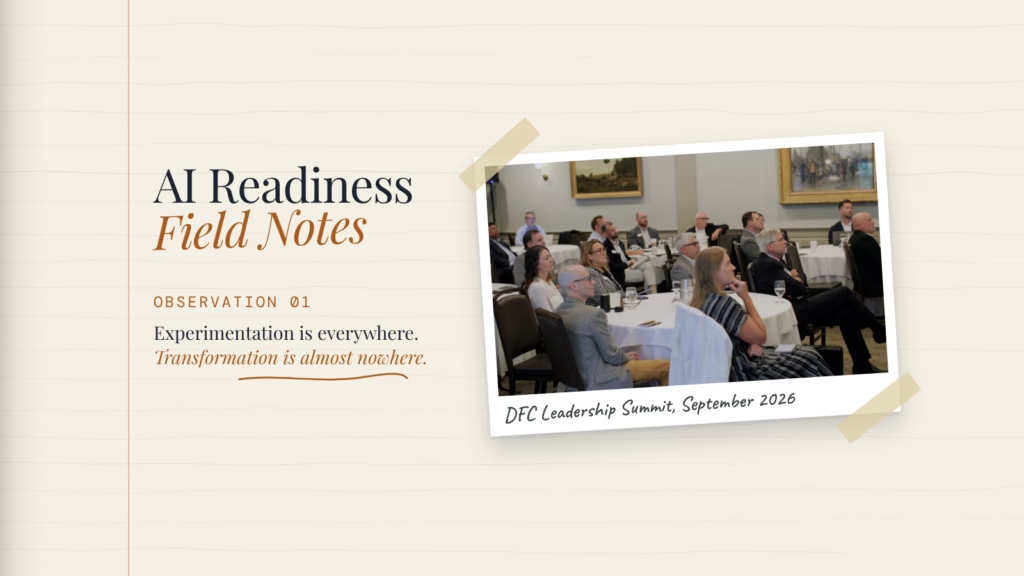
Observation 01: Experimentation is everywhere. Transformation is almost nowhere.
That’s our first observation in AI Readiness Field Notes.
Are design firms changing how they work because of AI?
Mostly, no. Firms are using AI to do the work they already do, faster. When they talk about AI in public, it’s usually about the tools they’ve adopted, the pilots they’ve run, and the technology roles they’re hiring for. We hear it in conversations with firm leaders, we see it in what they post online, and it shows up on their own websites.
The firm leaders at our September summit told a similar story. Around the tables, firms were at very different points on what one participant called a journey of “exploring, adopting, transforming,” and even inside a single firm, some people were further along than others. Most of the use people described sped up existing design work. Fees, staffing, training and the business model came up as questions people were still working through, not changes they’d made.
To be fair, a firm with pilots and tools to show may already be ahead of its peers. Plenty of others have published thought pieces with little action behind them, or have said nothing at all. Some may be moving quietly. But the silence suggests the harder questions are being worked out behind closed doors, if they’re being worked out at all.
Those harder questions sound something like this:
Questions we keep hearing
If AI can do much of the work that used to train young professionals, where will their judgment come from?
When time is no longer the proxy, how will value be measured?
If AI can produce every possible option, who in your firm is trained to recognize the right one?
None of them is really about tools. They’re about people, pricing, and accountability.
What the industry data shows
RIBA’s 2026 AI Report found that 74% of the architecture practices it surveyed now use AI, up from 41% in 2024. Only 19% have a documented AI policy. That’s a 55-point gap between using AI and setting any formal direction for it. Just 15% say AI is embedded in their day-to-day work.1
74% of practices use AI. 19% have a policy for it.
A 55-point gap between using AI and setting any formal direction for it.
Source: Royal Institute of British Architects, RIBA AI Report 2026. Survey of 1,100+ respondents, March to April 2026.
A policy isn’t a strategy, and it’s a fairly low bar. If four out of five practices haven’t written down how they use AI, it’s hard to believe many have decided what it should change about how they work.
What does AI readiness mean for a design firm?
AI readiness isn’t about how much a firm uses AI. At DesignIntelligence, we define it as adequacy relative to ambition: whether a firm can carry out what it wants AI to do for its work, its people, and its clients.
By that measure, speed isn’t the point. One table at our summit said AI “should not simply make architectural practice faster. It should be used to refound architectural practice around higher value.” The profession has been here before. As our AI SWOT guide noted, drawing on Phil Bernstein‘s work, architecture has become more productive without becoming more profitable.
In conversations since the summit, we keep coming back to a simpler question, one that comes before any decision about tools: are we doing better work? Is what we’re adding to the built environment better than what we added before? That’s where readiness starts. The tools matter because they can bring more value to projects and help clients imagine, collaborate, explore and end up with something better. Using them isn’t an accomplishment on its own.
One table summed it up in a sentence: “AI will allow us to speed up, enabling us to slow down, let people flourish and care for each other in order to do better work.”
“Experimentation is everywhere. Transformation is almost nowhere.”
Observation 01, AI Readiness Field Notes
Whether faster work turns into better work is much harder to measure than adoption. It takes strategy, not just tools, and that’s what our AI Readiness Study is designed to look at.
What comes next
Field Notes will keep coming back to this gap as the AI Readiness Study takes shape. The study launches later this month.
Subscribe to our newsletter to be first in line when the AI Readiness Study opens.
Sources
¹ Royal Institute of British Architects. (2026). RIBA AI Report 2026. RIBA. Survey conducted March to April 2026. https://www.riba.org/media/3f2bcutw/riba-ai-report-2026-aug.pdf
Design Futures Council. (2026, October 12). How to Run an AI SWOT Analysis at Your Design Firm. DesignIntelligence. https://www.di.net/dfc/articles/how-to-run-an-ai-swot-analysis-at-your-design-firm/