
Design creates enormous value. Scott Simpson, FAIA, principal at five architecture firms and CEO of two over a five-decade career, has spent that career trying to get the profession to say so in a language clients understand. He has been a Senior Fellow of the Design Futures Council since its earliest days.
Ahead of the DFC Leadership Summit on the Business of Design this September, we sat down with Scott to talk about the DFC, the business of design, and the language of value.
A Cruise Ship on Land
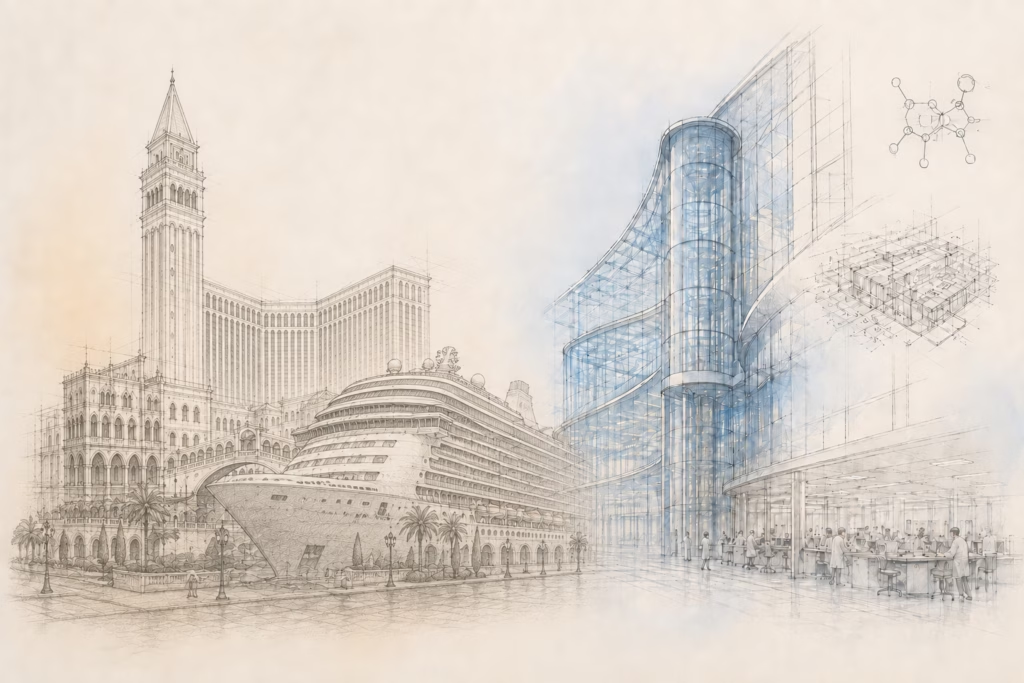
Ask Scott Simpson about Las Vegas in the late 1990s, and he’ll tell you it ran on three things: a free buffet, a show, and gambling. Sheldon Adelson, who had hired The Stubbins Associates to design the Venetian, saw a whole different business proposition. “Think about a cruise ship,” Scott says. “People pay you in advance, and once on board they’re a captive audience who buys the drinks and the t-shirts. If you applied that idea in Las Vegas, you could change the nature of the entire city.”
So the project designed for Adelson was never just a hotel. It was a convention center with a casino tagging along in a supporting role. Vegas hotels at the time ran around 60 to 75 percent occupancy, while the Venetian ran at 99 percent. Within ten years, Las Vegas had become the largest convention destination in the world. That success wasn’t just about the numbers. It also created a compelling sense of place, where people became willing participants in the fantasy. “That building is basically a cruise ship on land,” Scott says. “Once you understand that concept, you design accordingly, and it blows the doors off the creative possibilities.”
It’s a story Scott tells for a reason. Adelson didn’t ask for a casino with better sightlines. He had a different business model, and the design followed from it. “Business and design aren’t enemies,” Scott says. “They’re mutually reinforcing. Understanding how they complement each other enhances the creative potential of designers to do better work.”
“Business and design aren’t enemies. They’re mutually reinforcing.”
Scott Simpson, faia
Value Starts at the Brief
The value of design does not show up at the end of a project, at the ribbon cutting on opening day. It starts at the brief, as it did with Adelson. Scott saw it happen again at Novartis. In the early 2000s, Novartis came to Scott’s team with a demanding ask: a world research headquarters in Cambridge. The lab itself wasn’t the hard part. Recruiting was. Mark Fishman, the physician-scientist recruited from Massachusetts General Hospital to lead the project, needed top researchers to leave established positions for a new enterprise.
So the brief changed: build something that inspired people to say, “I have to work here!” the moment they walked through the front door. Scott’s team at The Stubbins Associates delivered it inside an old candy factory, renovated top to bottom. Since the structure couldn’t be altered externally, a large amoeba-shaped atrium was created within, complete with custom-fabricated glass elevators that made the lobby feel like a vertical living room. The main laboratory wing ran the length of a football field, one open room instead of a row of separate labs, reconfigurable like pieces on a chessboard. Conference rooms and elevators were sheathed in glass, so people could see who was meeting and who was around.
Scott calls the underlying idea “changing the sociology of science,” designing labs to encourage scientists to interact with each other. The building wasn’t just solving an architectural problem. It was solving Novartis’s actual problem: attracting the best people in the world, then getting them talking to each other.
The brief is where value starts, but it’s also where it often goes untapped and uncommunicated. In Scott’s telling, an owner walking into an architect’s office asks two questions: how much will it cost, and how much will it hurt? “If you’re speaking French and they’re listening in German, there’s a gap,” he says. Closing that gap is as much the architect’s job as the drawings themselves.
The brief is where value starts, but it’s also where it often goes untapped and uncommunicated.
Continue the Conversation
The Venetian and the Novartis lab both show the value in treating design as an answer to a business question, not a decoration on top of one. This is one of two inseparable ideas DFC has held since its earliest days. The other is that design and business aren’t opposing forces but are mutually dependent, that a firm has to be financially healthy to do its best creative work. Both remain industry-wide blind spots, and closing them is what the Design Futures Council has spent decades doing.
That argument has new urgency now. AI and a wave of new technology are forcing every firm to answer a version of the same question: what is design actually worth to a client, and can the profession learn to say so before the client decides it for them?
What is design actually worth to a client, and can the profession learn to say so before the client decides it for them?
Scott will take that question further this September, in a session with Phil Bernstein at DFC’s Leadership Summit on the Business of Design in Cambridge, Massachusetts. Join us there.
These two stories are only part of the conversation. DFC will release a longer, in-depth interview with Scott in the coming weeks, going further into the Venetian, Novartis, and the questions DFC has convened around from the start.